


The Synthesis Manifesto came across my feed this morning: twelve principles for people who build, write and decide with AI every day and want the work to survive contact with next week.
Most documents in this genre are written at a level of abstraction where nobody could possibly disagree. Be responsible. Keep humans in the loop. This one is not that. It makes claims specific enough to be inconvenient. Archive first, delete second. Partial work says so, plainly. Nothing ships silently incomplete. The tool is a guest in the work, not its landlord. Those are not sentiments, those are constraints, and a few of them would have saved me real money if I had been holding to them a year ago.
The one I keep coming back to is the second. Work arrives with its evidence. Progress that cannot show itself is a claim, not a result.
So let me arrive with some.
What follows is four incidents from the last year, each dated, each with a cost. Two of them are underneath principles already in the document, and the only thing I am adding is the receipt. Two of them are not in the document, and I would like to make the case for them.
First, why any of this needs writing down
I can build things now that I could not have built three years ago. So can you. That is good news and I am not going to pretend otherwise. I am not about to argue that people should stay in their lane.
Here is the part we have not caught up to.
The friction is gone from production. It was never there in verification. You can generate a working service, a confident number, or a clean-looking audit faster than you can check any of them. That gap used to be closed by plain incompetence: if you could not build the thing, you could not ship the thing. The difficulty of building was doing quiet quality-control work that nobody ever credited it for.
That check is gone. Nothing replaced it.
Everything below is a corollary of that one fact, including all twelve of theirs.
1. Never describe a surface you didn’t touch.
This is their first principle — verify against the source, not memory. Here is the receipt.
I audited 161 documents my own agents had written, looking for what predicted fabrication. I expected the answer to be about care. Rushed sessions, vague instructions, that sort of thing.
It turned out to be access. Every fabricated document was written by a session that could not reach the thing it was describing. Every document written by a session that could reach it was clean. Careful sessions without access still invented things. Care was not the variable. Reach was.
The fabrications had a fixed shape, and I want to describe it, because once you have seen it you cannot unsee it: an invented mechanism between two real nouns. Both endpoints correct. The verb joining them made up, complete with a plausible name and a version number. The accurate core is exactly what lets it survive a skim.
People do this too. People have always done this. The difference is throughput.
So name the check, not the conclusion. “I ran this command and this came back” beats “the service is running.” A reader can re-run the first one.
2. A negative result is not a negative finding.
Also theirs, and the sharpest edge of it. Verifying against the source assumes you asked the source the right question.
I searched a codebase for a class called `RecommendationEngine`. Nothing came back. I concluded the library was dead and filed a substantial piece of work to tear it out.
The class was called `RecEngine`. `RecommendationEngine` was a prose name in a docstring. The real class was being instantiated on every single request. I had overturned a correct earlier finding on the strength of a search for a name that was never in the code.
Here is why this one is nastier than it looks. “I searched and found nothing” and “I searched for the wrong string” produce identical output. There is no tell. You cannot feel the difference between them.
And a negative is only ever as wide as the place you looked. That same week I reported that a deploy script did not exist. True of the box I had checked. False of the laptop where the file actually lived. The claim I made was wider than the search I ran.
So state the scope, not just the result. And when a name-search comes back empty, go open the thing that would have called it.
---
And also — two more, offered in the same spirit.
3. Price the plan where the work multiplies, not at the query.
I once turned a single research question into about nine agents, each opening about a hundred pages. It hit a spending limit mid-run. Eight of them died with their findings unrecoverable.
Nothing in that path was careless. Every individual step was reasonable. The plan was simply never priced, because there was no moment that felt like the moment to price it.
Cost lives at the boundary where work multiplies, not in any single call. And the instinct to put a check at the single-call level is wrong — a per-query confirmation taxes everything you do and gets routed around inside a week.
Count the fan-out. Say the number out loud before you launch it. That is arithmetic, not process.
I suspect this is absent from most codes of conduct in this space because it does not present as an integrity problem. It presents as a budgeting problem. It is an integrity problem: the eight agents that died had findings in them, and nobody will ever know whether those findings were the good ones. An answer that is missing its most expensive third is not a cheaper answer. It is a wrong one, delivered confidently.
4. Don’t cite a number you couldn’t reconstruct.
Not “understand your metrics.” That is 2015 advice. Rebuild them. If you cannot re-derive a number you cannot defend it, and you do not own it — you are forwarding it.
Here is the page that made me write this rule down. I am not naming the company. The numbers are quoted exactly as published.
It leads with 99.5%: “Verified Accuracy. Validated across 42M real-world questions.”
Further down, the same figure: “99.5% validated accuracy across 8M daily queries.”
Further down again, a third time: “99.5% accuracy, every interaction logged.”
One number, three populations. Forty-two million questions. Eight million daily queries. Every interaction there has ever been. A real measurement does not survive a change of denominator unchanged. If it does, it was never a measurement. It was a decoration.
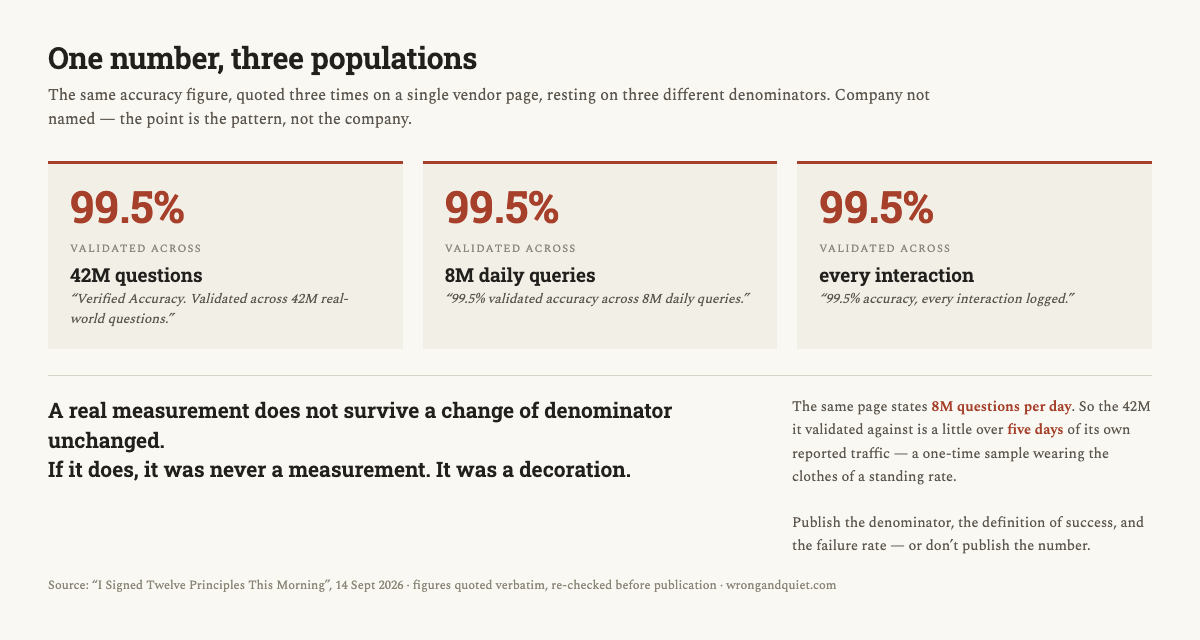
The same page states 8M questions per day. So the 42M it validated against is a little over five days of its own reported traffic — a one-time sample wearing the clothes of a standing rate.
And the same page promises “Your infrastructure. Your models. Your control.” If the customer brings the models, the vendor cannot know the accuracy of the model the customer picks.
There is very likely a real and useful number underneath all of this. Something like how often retrieval actually grounds an answer in its source. That would be worth publishing. It is also far narrower than what 99.5% implies when it sits in a row of compliance badges.
I am not naming them, because the point is not that one company did this. The point is that AI now hands you benchmarks and eval results and percentages without the friction that used to force you to understand a number before you could produce one.
The rule in positive form: publish the denominator, the definition of success, and the failure rate — or don’t publish the number.
I re-checked that page this morning, before writing this, because a piece arguing that you should check the number cannot ship a number it did not check. All three figures are still there.
The credential is the retraction
I have published numbers that later needed correcting. A linkage figure went stale within a day of the very fixes that changed it. A recall claim I dropped rather than defend. A core differentiator I had built real positioning on, falsified by my own research.
I am not listing those to perform humility. I am listing them because a standard proposed by someone who has never had to retract anything is not a standard, it is a posture. These four rules are not things I believe. They are things that happened to me, and the rules are what I wrote down afterward so they would not happen twice.
Which is also why I signed a document I did not write. Twelve is the right length for a shared standard — it has to cover ground I have not personally walked, and most of it does. Four is the right length for a field report, because four is how many times I have been burned badly enough to change how I work. The two are not competing. One is the agreement, the other is the evidence, and the agreement is worth more than the evidence right now because more people have signed it than have written up what it cost them.
So: go read it. Sign it if it is yours. And if you have your own four, write them down, because that is the part that does not scale and cannot be borrowed.
Production outruns verification now. That is the whole thing. Everything else is a corollary, and the corollaries are cheap. The incidents are what cost something.