


In a redaction system I built for legal documents, the word son was classified as a corporation. So were alleges, relief, logged, except, framed, serve, described, known, unenforceable, and law.
None of those is a close call. They became companies because of one entry in a list of corporate suffixes: as. AS is the Norwegian company suffix — Aksjeselskap. It had every right to be on the list.
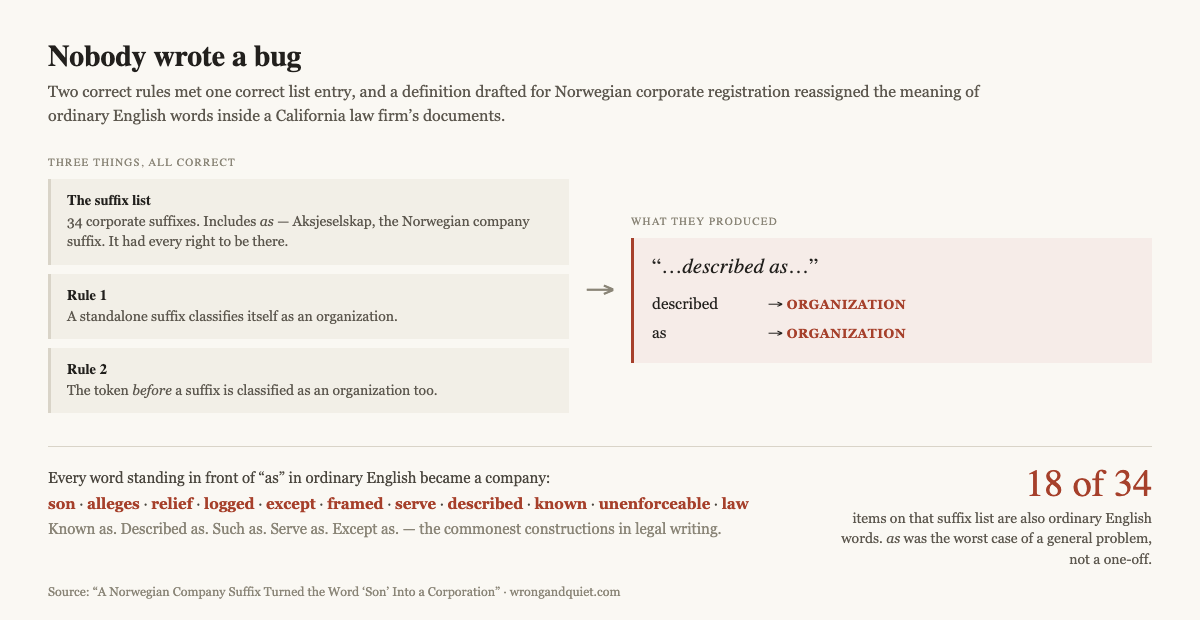
Two rules met that entry. A standalone suffix classifies itself as an organization. And the token before a suffix is classified as an organization too. So as became a company on its own, and then every word standing in front of the word “as” in ordinary English became one as well.
Known as. Described as. Such as. Serve as. Except as.
The commonest constructions in legal writing.
Nobody wrote a bug. Two correct rules met one correct list entry, and a definition drafted for Norwegian corporate registration reached into a California law firm’s documents and quietly reassigned the meaning of English words. It wasn’t even an unusual entry — 18 of the 34 items on that suffix list are also ordinary English words. as was the worst case of a general problem, not a one-off.
I want that on the table before I make the larger argument, because the larger argument is the one people get wrong.
The same shape, one layer up
I wrote a while back about why no growing company can tell you what it sold last month: two ledgers, two definitions of the same event, neither authoritative, and whichever figure the person building the board deck happened to pull. (https://wrongandquiet.substack.com/p/i-owned-my-first-computer-outright)
That is the son failure at business scale. Somebody else’s definition of a word, running inside your business, deciding what’s true.
The part I have to concede
Here’s where I’d expect this to turn into an argument for owning everything, so let me kill that now: renting is usually right, and I’ve made that case at length elsewhere.
The concession that matters here is narrower, and worse for me. The son cascade happened in a system I own outright. I wrote it. I ran it. Ownership bought me exactly no protection from a bad definition.
So the line is not “own everything.” Nobody sane is arguing that — least of all someone whose own engine just turned a Norwegian suffix loose on English.
What ownership actually buys
It buys you the ability to go look.
When I found the cascade, the fix was available to me: a legal suffix only counts as a suffix when it’s written in entity case. Legal documents capitalize entities — Dorsey Holdings LLC, HOFFMAN & ASSOCIATES, Nordisk AS — and the function-word uses are lowercase. No English stopword list to maintain. The signal was already in the data.
Then I could measure it, and I re-ran that measurement rather than quoting myself. Across 25 documents in seven matters, the engine mints 39 identity pseudonyms, and 4 of 254 cross-matter pairs are joinable by a genuine name. That’s 1.6%.
There’s a second number sitting directly above it: 125 of 254, 49.2%, if you count the firm’s own letterhead and the homographs I deliberately left coded. The tool prints a line telling me which one to use — the cross-matter figure above is the NAIVE number and is NOT the floor. Quote the floor. I wrote that warning into the tool because I’d misread my own output once.
That is what having the definitions in your building looks like. Not that they’re right. That the argument about which number is honest happens where you can reach it.
None of those four moves — see it, name it, fix it, measure it — is available to you on a rented definition. On rented infrastructure, “the token before a suffix gets absorbed” isn’t a bug you found. It’s a behavior you live with, and you will most likely never learn it exists.
I have the rented version too. We sent keyed legal documents to a hosted model: of 127, thirty-nine came back refused. That’s 30.7%. The same documents unkeyed, same model: zero. So it wasn’t the content — it was what our own keying did to it, meeting a rule inside somebody else’s building that we could not read.
I wanted to know whether that was one vendor’s judgment or a property of the work, so we ran a second provider. Zero refusals there. But I can’t claim that comparison at all, and the run file says so in its own summary: 34 of 40 keyed responses hit our output cap, so the two arms were never on equal terms. What I actually have is one vendor refusing 30.7% of a corpus, another refusing none, and an open question about why. (The longer write-up: https://wrongandquiet.substack.com/p/whats-in-a-name-everything-to-one)
Same shape as son, one layer up. Somebody else’s definitions, running inside your business, changing when they decide.
The honest version of the ledger problem
I run my own content pipeline end to end. Every part of it is mine.
For several days it told me three pieces were attributable. The number never moved and the job exited cleanly every time, which is what made it invisible. The ledger it read had moved to a new version; the poller was still reading the old one. Both halves were individually correct — the poller worked, the new ledger was canonical — and only the edge between them had rotted. 3 was not a result. It was a default wearing a result’s clothes.
Two systems, one number, no error, wrong answer. On a stack with no landlord in it at all.
That’s the honest limit of the argument. Ownership doesn’t make your systems agree. What it did was let me open both halves and find the seam in an afternoon. Rented, that number stays 3 forever, and I go on quoting it.
Why I’m building a box
So what I’m building is an appliance — a box that lives in the customer’s building, on their own network, with the model running on it and the judgment accreting on it.
Not because the definitions inside it would be right. Mine weren’t. I had a Norwegian company suffix eating English words in mine, and it took an afternoon to find out.
Because when a definition inside your business turns out to be wrong, somebody has to be able to reach it.
Wait… Mollick or Moloch? Fair either way. It's written from inside the work, not above it… learning the hard way and paying it forward. I'd definitely rather be told when it starts sounding like the machine. Thanks for reading it that closely.
A bit of Mollick style insider-for-profit AI and scale here, Patrick, ty for sharing.